Loading game…
Click anywhere to start
Shogi
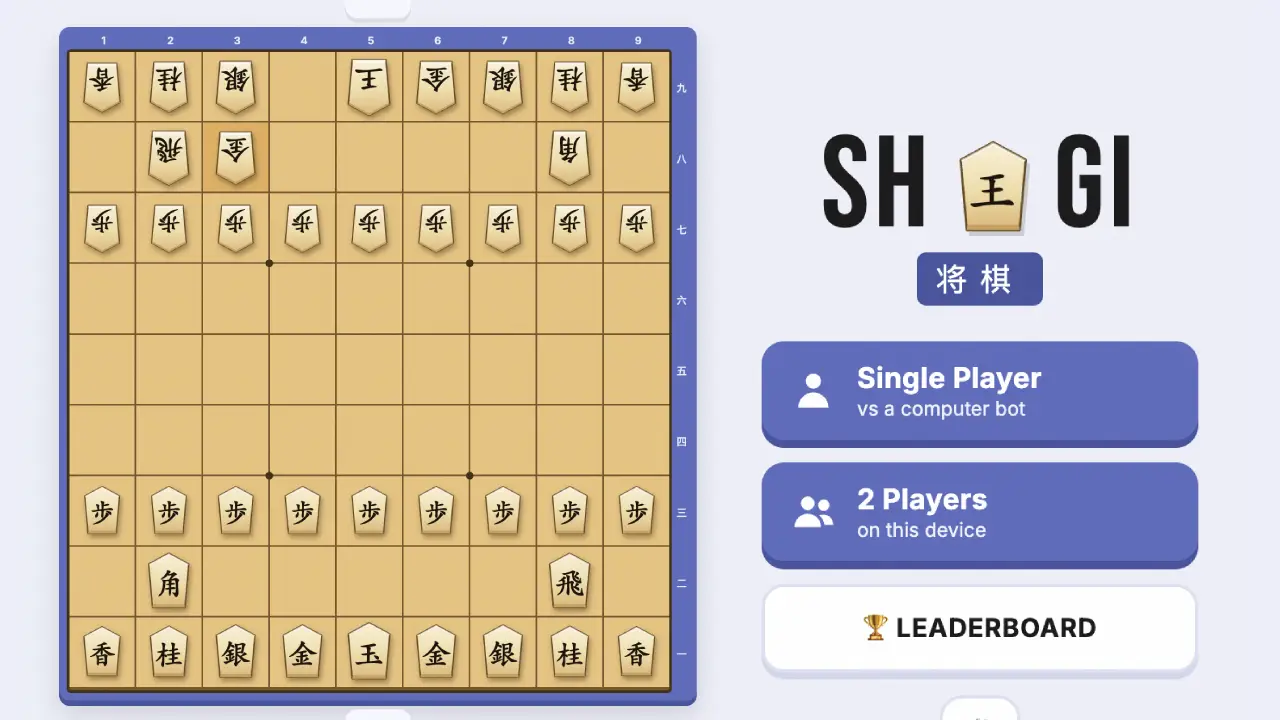
Play Shogi, the classic Japanese chess game, free online. Face a computer opponent with an ELO rating or play local 2-player on one device - with real drops (captured pieces return to your hand as your own) and piece promotion. No online multiplayer, no download, no sign-up.

Lakeview Angler

Snake Rush
2048

Checkers Classic
Carrom Rush
Reversi Classic

Cricket Clash
Minesweeper Classic
Word Search
Mahjong Solitaire
Backgammon Classic
Shogi
Euchre
Dominoes
Typing Practice
FreeCell Solitaire

Wild Bounty: Hunter 3D
Gomoku

Canasta

VoxelGun.io
Daifugo
Pinochle
Mini Golf Rush 3D

3D Basketball Rush
8 Ball Legend
Chess
Four in a Row
Zombie Survivor
DeveloperBrave Games
ModesSingle player · Local 2-player
ReleasedJuly 2026
TechnologyHTML5
PlatformBrowser (desktop & laptop)
How to Play
Shogi is Japanese chess — a two-player strategy game with a twist no other chess variant matches: captured pieces switch sides. Every piece you take goes into your hand, and on any later turn you can drop it back onto the board fighting for you, so no lead is ever safe and comebacks are part of the game's soul. Pieces promote too: reach the far side of the board and the game asks — in Japanese and English alike — whether to promote (成る) or keep (不成), trading a piece's old powers for stronger ones. This free browser version plays instantly with no sign-up and no download: choose your computer opponent — eight bots from Beginner (ELO 400) to Expert (ELO 2000), or Random if you like surprises — and your own ELO rating starts at 1200 and moves with your results — or share one screen in local 2-player, with the traditional ▲ and △ marks showing whose move it is. Undo, a full move list, resignation, and a leaderboard round it out, and the bilingual interface teaches you the traditional terms as you play. There's no online multiplayer — just shogi, the deepest comeback game ever designed, in HTML5.
Browser Controls
- Move a Piece: Click or tap a piece, then its destination. The ▲ and △ marks by each player show whose turn it is — ▲ moves first, just as in traditional shogi.
- Drop a Captured Piece: Pieces you capture appear in your hand panel (持駒). Select one and place it on the board as your move — dropping at the right moment is where shogi games are won.
- Promote or Keep: When a piece reaches the promotion zone, the game asks 成りますか? — Promote this piece? Choose 成る (Promote) for its stronger form, or 不成 (Keep) when the original movement serves your plan better.
- Undo, Resign & Moves: Undo takes back your last move — a friendly luxury shogi etiquette normally forbids. Resign concedes a lost game, and the move list records the whole battle for review.
- Settings: Toggle music, koma and game sounds, and visual effects (particles and animations) any time from Settings.
- Piece Style: Switch between traditional kanji pieces and Western letters (K, R, B, G, S, N, L, P) any time — from Settings, the home screen, or the button beside the board. Promoted pieces show as +R, +B and so on, and stay red.
Special Rules
- Drops: Captured pieces join your side. On any turn, instead of moving a piece on the board, you may drop one from your hand onto the board — the rule that makes shogi endlessly dynamic and nearly impossible to play out to a dead draw.
- Promotion: Pieces that reach the far zone of the board may promote to a stronger form — the game offers the choice each time (成る to promote, 不成 to keep). Promoted pieces revert when captured, so power never leaves the game.
- Check & Checkmate: Trap the enemy king with no escape and the game is won — but remember your opponent's hand: a checkmate that a single drop can block is no checkmate at all.
- ELO Rating: In single player your rating starts at ELO 1200 and moves with your results against the computer bots — a simple running measure of how your shogi is improving.
- Choose Your Opponent: Single player opens with an opponent picker — eight bots ranked from ELO 400 (Beginner) to ELO 2000 (Expert), plus a Random option. Your last pick is remembered for next time.
The Shogi Pieces
- King (王/玉): Moves one square in any direction. Lose it and the game is over — every plan begins and ends with the king's safety.
- Rook (飛) & Bishop (角): Your major pieces: the rook slides any distance along ranks and files, the bishop along diagonals. Promoted, they become the Dragon and the Horse, adding one-step king moves to their reach.
- Gold General (金): One step in any direction except diagonally backward. Golds never promote — they're already the shape most pieces promote into, and the king's most loyal defenders.
- Silver General (銀): One step forward or diagonally — nimble attackers that are often better left unpromoted, since a promoted silver moves like a gold and loses its retreat.
- Knight (桂): Leaps two squares forward and one to the side — the only piece that jumps, and it only ever jumps forward. Place it with care; it can never come back on its own.
- Lance (香) & Pawn (歩): The lance charges any distance straight ahead; the pawn steps one square forward and captures the same way. Both promote into gold movement deep in enemy territory — a promoted pawn is one of shogi's deadliest bargains.
Read the full guide: How to Play Shogi — rules, pieces & drops →
Frequently Asked Questions
What is shogi?
Shogi is the Japanese form of chess, played between two players on a board with pieces that promote and — uniquely — return to play after capture. It's often called Japanese chess, and it's one of the deepest strategy games in the world. This free browser version offers single player against computer bots with an ELO rating, and local 2-player on one device, with no download and no sign-up.
How is shogi different from chess?
The heart of it is drops: in shogi, captured pieces join the capturing side and can be played back onto the board, so material never leaves the game and no lead is ever safe. Most pieces also promote to stronger forms deep in enemy territory. The result is a game with almost no dead draws and constant comebacks — if chess is a battle of attrition, shogi is a battle of momentum.
What are drops in shogi?
When you capture a piece, it goes into your hand — shown in the 持駒 panel beside the board. On any later turn, instead of moving a piece, you may place one from your hand onto the board, where it fights for you. Timing a drop — a knight into the enemy camp, a pawn to blunt an attack — is the defining skill of the game.
How does promotion work?
When a piece reaches the promotion zone on the far side of the board, the game asks 成りますか? — Promote this piece? — and you choose 成る (Promote) or 不成 (Keep). Promotion trades a piece's movement for a stronger form; keeping is occasionally wiser, since some pieces lose useful moves when they promote.
Do I need to know Japanese to play?
No. The interface is bilingual — prompts appear in Japanese and English side by side (成りますか? / Promote this piece?), so nothing blocks you, and you pick up the traditional terms naturally as you play. It's a friendly way for chess players to step into the Japanese game. And if the kanji pieces themselves are the hurdle, switch on Western letter pieces in Settings.
Can I play shogi against the computer?
Yes — and you choose which one. Single player opens with a picker of eight bots ranked from ELO 400 (Beginner) to ELO 2000 (Expert), plus a Random option, and your last pick is remembered. Your own ELO rating, which begins at 1200, moves with your results so you can track your progress.
Can I play shogi if I can't read kanji?
Yes. The Western Pieces toggle swaps the kanji for international letters — K, R, B, G, S, N, L, P, with promoted pieces shown as +R, +B and so on in red. Flip it any time from Settings, the home screen, or during a game; the wooden koma shapes, the board, and the traditional notation stay exactly the same.
Can two people play on the same device?
Yes. Local 2-player mode lets two people take turns on one screen — the ▲ and △ marks track whose move it is, just like sente and gote in traditional play. No second device or account needed.
Can I play shogi online against friends?
No. There is no online or networked multiplayer. Single player is against computer-controlled bots, and 2-player mode is local play on one shared device.
Is it free, and do I need to download anything?
Yes, it's completely free — Shogi on Playgami has no sign-up and no payment. It's an HTML5 browser game that loads instantly: no downloads, no installs, no plugins.